


Metsolarlight
Neng Yue Series All-in-One Solar Street Light
Neng Yue Series All-in-One Solar Street Light
The Neng Yue Series All-in-One Solar Street Light is designed for outdoor lighting projects that need easier installation, stable illumination and flexible power options. The series combines the LED light source, lithium battery, controller and solar panel into one complete solar lighting system, reducing wiring work and making project installation more efficient.
With 50W, 60W and 120W models available, the Neng Yue Series can support different installation heights from 4m to 10m. It is suitable for rural roads, residential communities, parks, campuses, courtyards, private roads, industrial areas and other outdoor lighting applications.
Product Specifications
Neng Yue 1
Model:Neng Yue 1
Power:50W
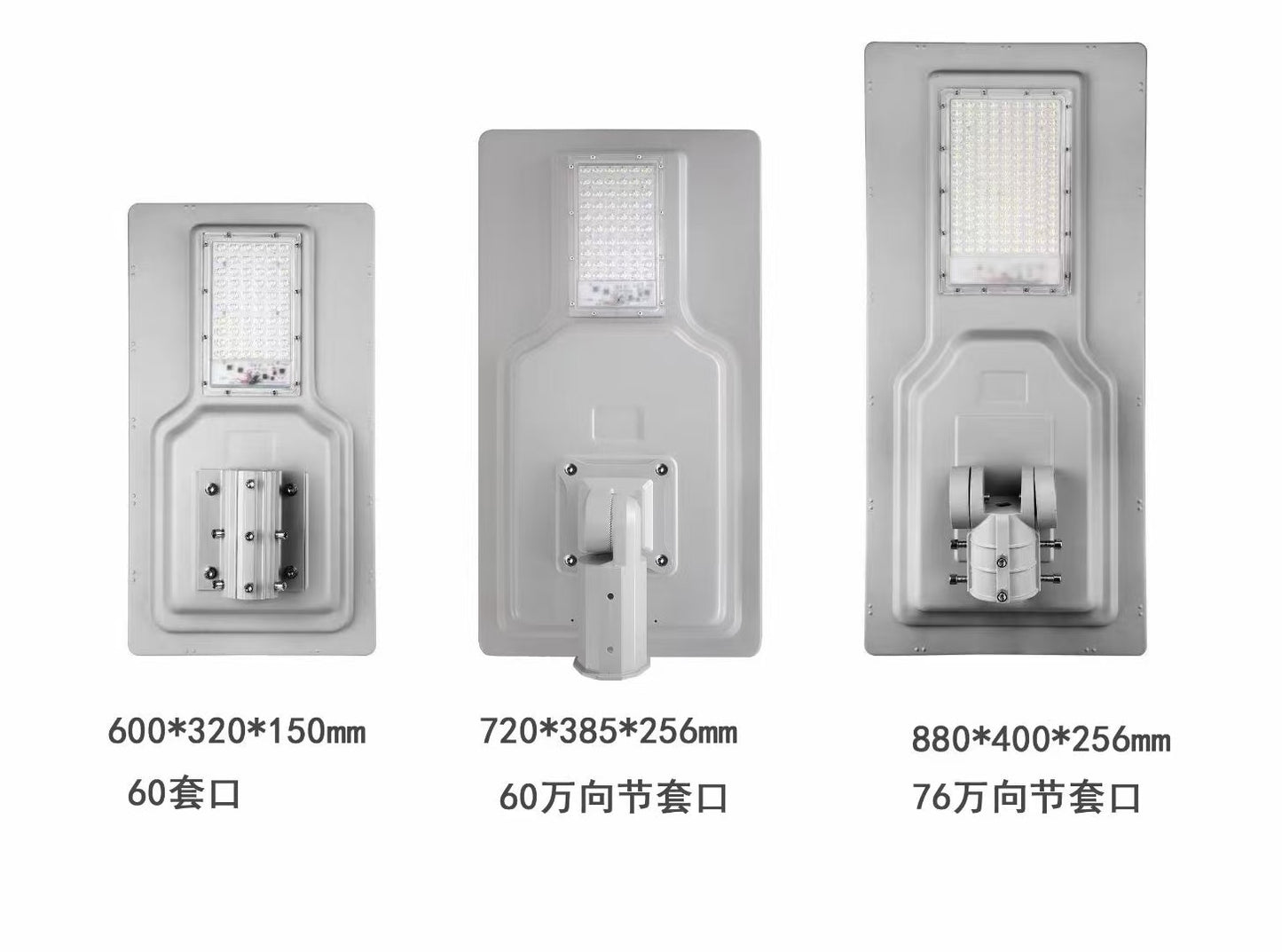
Lamp Size:600 × 320 × 150 mm
Lamp Body Material:Galvanized metal material
Battery:3.2V / 50Ah
Controller:Integrated 20A control board
Solar Panel:6V / 50W monocrystalline silicon
Lighting Time:6–12H
Control Mode:Light control + time control, remote control supported
Color Temperature:6000K
Working Temperature:-30°C to 50°C
Working Time:12H per day, designed to support rainy days depending on sunlight and settings
LED Lifespan:>60,000 hours
Protection Grade:IP65
Mounting Diameter:Ø60mm / Ø76mm
Recommended Installation Height:4–6m
Packing Quantity:2 pcs/carton
Neng Yue 2
Model:Neng Yue 2
Power:60W
Lamp Size:720 × 385 × 150 mm
Lamp Body Material:Galvanized metal material
Battery:3.2V / 65Ah
Controller:Integrated 20A control board
Solar Panel:6V / 60W polycrystalline silicon
Lighting Time:6–12H
Control Mode:Light control + time control, remote control supported
Color Temperature:6000K
Working Temperature:-30°C to 50°C
Working Time:12H per day, designed to support rainy days depending on sunlight and settings
LED Lifespan:>60,000 hours
Protection Grade:IP65
Mounting Diameter:Ø60mm / Ø76mm
Recommended Installation Height:6–8m
Packing Quantity:1 pc/carton
Neng Yue 3
Model:Neng Yue 3
Power:120W
Lamp Size:880 × 400 × 256 mm
Lamp Body Material:Galvanized metal material
Battery:3.2V / 120Ah
Controller:Integrated 30A control board
Solar Panel:6V / 100W monocrystalline silicon
Lighting Time:6–12H
Control Mode:Light control + time control, remote control supported
Color Temperature:6000K
Working Temperature:-30°C to 50°C
Working Time:12H per day, designed to support rainy days depending on sunlight and settings
LED Lifespan:>60,000 hours
Protection Grade:IP65
Mounting Diameter:Ø60mm / Ø76mm
Recommended Installation Height:8–10m
Packing Quantity:1 pc/carton
Integrated Solar Lighting System
The Neng Yue Series combines the solar panel, battery, LED lamp and controller into one complete lighting solution. This makes installation simpler and helps reduce the need for external wiring.
Three Model Options for Different Heights
The series includes three main options:
Neng Yue 1:50W, recommended for 4–6m installation
Neng Yue 2:60W, recommended for 6–8m installation
Neng Yue 3:120W, recommended for 8–10m installation
This allows buyers to select the right model according to road width, pole height and lighting requirements.
Durable Galvanized Metal Housing
The lamp body uses galvanized metal material, designed for outdoor environments. The structure is suitable for long-term road lighting and area lighting projects.
Light Control + Time Control
The system supports light control and time control. Remote control adjustment is also available, making it easier to manage lighting schedules for different project needs.
IP65 Outdoor Protection
With IP65 protection, the Neng Yue Series is suitable for outdoor use in rain, dust and changing weather conditions.
Flexible Pole Diameter
The series supports Ø60mm and Ø76mm pole diameter options, making it easier to match common outdoor lighting pole structures.
Recommended Applications
Rural roads
Residential communities
Private roads
Courtyard roads
Campus roads
Park roads
Industrial areas
Parking areas
Outdoor public areas
Low to medium traffic road lighting projects
For 4–6m lighting projects, Neng Yue 1 is the most cost-effective choice. For 6–8m community or park roads, Neng Yue 2 offers a balanced configuration. For 8–10m road lighting projects that need higher output, Neng Yue 3 is the stronger option.
Why Choose Neng Yue Series
The Neng Yue Series is suitable for buyers who want a practical all-in-one solar street light with multiple power choices. The integrated structure helps simplify installation, while the three model options make it easier to match different road widths and pole heights.
For projects in rural roads, residential areas, parks and private outdoor spaces, this series provides a direct and efficient solar lighting solution with stable LED output, IP65 outdoor protection and flexible control modes.


FAQ
Q55. What information is needed for facade-lighting design?
A. Provide wall dimensions, material and color, fixture position, required lighting effect, project location, operating hours, control requirements, site photos or drawings, and quantity.
Q54. Can solar wall washer lights work all night?
A. All-night operation depends on solar-panel size, battery capacity, power level, lighting program, local sunlight, and rainy-day requirements. A project energy calculation is recommended.
Q53. Can the lighting color be customized?
A. White-light color temperature and colored-light options may be available depending on the LED configuration and controller. Static color, RGB, or programmed effects must be confirmed by model.
Q52. What is the current MET Solar wall washer model?
A. The current website lists Solar Wall Washer Light XQD300-900. Available lengths, power, color, optical angle, battery, solar panel, and control modes must follow the product specification.
Q51. What is a solar wall washer light?
A. A solar wall washer light projects linear light across a wall or facade to highlight architectural surfaces, landscape walls, signs, entrances, and outdoor features without relying entirely on grid wiring.
Q50. Can the finish or color be customized?
A. Finish color and branding may be customizable for project orders, depending on the model, coating process, quantity, and approved sample.
Q49. How is the wall light fixed?
A. The mounting surface should be solid and level, and the correct anchors or screws should be selected for concrete, brick, metal, or wood. Cable openings and screw holes should be sealed for outdoor use.
Q48. Do solar wall lights use motion sensors?
A. Some models may support motion sensing or multiple lighting modes. Sensor type, detection range, dimming level, and operating time must be confirmed for the selected model.
Q47. Can solar wall lights be installed under eaves?
A. Only when the solar panel can still receive enough direct sunlight. Deep eaves or north-facing shaded walls may cause insufficient charging unless a remote solar panel is used.
Q46. Where should the solar panel face?
A. The solar panel should face the direction with the strongest and longest daily sunlight, without obstruction from roofs, trees, walls, or nearby structures.
Q45. What is a solar wall light?
A. A solar wall light is a wall-mounted outdoor luminaire powered by solar energy, commonly used for entrances, corridors, courtyards, fences, villas, community buildings, and landscape walls.
Q44. What should be checked before bulk installation?
A. Confirm the pillar dimensions, solar exposure, mounting method, color temperature, light distribution, finish color, waterproofing details, and sample appearance before mass installation.
Q43. Will the light turn on automatically?
A. Most solar pillar lights use dusk-to-dawn control, but lighting modes and controller functions vary by model. Confirm the operating mode before ordering.
Q42. Can a solar pillar light be installed on an existing wall column?
A. Yes, if the column is structurally sound, level, large enough for the mounting base, and exposed to sufficient sunlight. Existing finishes and waterproofing must be protected during installation.
Q41. How do I choose the correct base size?
A. Measure the pillar-top dimensions and confirm the mounting plate, screw positions, edge clearance, and waterproof sealing method. The lamp base must be compatible with the actual column size.
Q40. Where are solar pillar lights commonly used?
A. They are commonly used at villa gates, residential entrances, boundary walls, garden walls, community entrances, courtyards, hotels, and landscape projects.
Q39. What is a solar pillar light?
A. A solar pillar light is mounted on top of a gate post, wall column, fence pillar, or entrance column to provide localized outdoor lighting without long-distance grid wiring.
Q38. Are solar lawn lights waterproof?
A. Outdoor models are designed with weather protection, but the exact IP rating must follow the selected product specification. Installation should avoid long-term water immersion unless the model is designed for it.
Q37. What spacing should be used between lawn lights?
A. Spacing depends on brightness, beam pattern, mounting height, landscape purpose, and desired visual continuity. A trial layout or photometric plan is recommended for projects.
Q36. Can solar lawn lights work under trees?
A. They may work only if the solar panel receives sufficient direct sunlight. Heavy shade can reduce charging, shorten lighting time, and accelerate battery cycling.
Q35. How much sunlight is needed?
A. The solar panel should receive several hours of direct, unobstructed sunlight each day. Required charging time varies with panel size, battery capacity, season, latitude, and weather.
Q34. Do solar lawn lights need electrical wiring?
A. Standalone solar lawn lights normally use an integrated solar power system and do not need long-distance grid wiring. Installation still requires secure mounting and adequate sunlight.
Q33. What is a solar lawn light?
A. A solar lawn light is a low-height outdoor luminaire used for pathway guidance, landscape accents, lawn edges, flower beds, courtyards, villas, and community green areas.
Q33. What maintenance is required?
A. Clean the solar panel, remove leaves or bird droppings, check for new shading, inspect fasteners and coatings, and monitor lighting time and battery performance.
Q32. How are solar garden lights selected for a project?
A. Select the model based on installation height, required brightness, spacing, optical distribution, style, solar exposure, lighting hours, and landscape design. A site layout or lighting plan improves accuracy.
Q31. Can the color temperature be customized?
A. Color temperature options may be available according to the LED module and order requirements. Common project choices include warm white, neutral white, and cool white, but the available range must be confirmed by model.
Q30. Do solar garden lights require underground cables?
A. Standalone solar garden lights normally do not require long-distance grid cables, but foundations, grounding, internal wiring, and any optional external power connection must follow the product and project design.
Q29. Where can solar garden lights be installed?
A. They are suitable for gardens, courtyards, residential communities, villas, parks, pedestrian paths, commercial landscapes, hotel grounds, and industrial-park landscape areas with sufficient sunlight.
Q28. What installation heights are available for solar garden lights?
A. Available heights depend on the model and pole configuration. Some MET Solar garden-light products are designed for approximately 3-, 4-, or 5-meter installations, while the final height must follow the selected model and project design.
Q27. What is a solar garden light?
A. A solar garden light is a freestanding outdoor luminaire powered by a solar panel and rechargeable battery, designed to provide functional and decorative lighting for gardens, courtyards, pathways, villas, communities, and landscape areas.
Q26. Does the multifunctional pole support grid, solar, or hybrid power?
A. Power architecture can be designed around the selected modules and site conditions. Whether the project uses solar, grid power, or a hybrid system must be confirmed during engineering design.
Q25. Can flags and advertising signs be changed after installation?
A. Replaceable flag, banner, or signage modules can be designed, but attachment method, dimensions, wind load, access equipment, and local approval requirements must be confirmed in advance.
Q24. How are cables and devices maintained?
A. Cable routing, access doors, brackets, electrical protection, device height, and replacement space should be planned during design. A module-level maintenance plan is recommended before installation.
Q23. How is structural safety evaluated?
A. Structural design should consider pole height, equipment weight, projected wind area, local wind speed, foundation, material grade, wall thickness, welding, and surface treatment. A project-specific structural review is recommended.
Q22. What information is needed for a multifunctional pole design?
A. Provide the project location, pole height, module list, equipment dimensions and power consumption, wind-load requirement, installation drawings, foundation conditions, communication method, lighting target, quantity, and branding requirements.
Q21. Can CCTV cameras and wireless equipment share the solar power system?
A. This is possible only after a project power-load calculation. Camera, wireless device, lighting, controller, solar-panel, battery, and backup-time requirements must be evaluated as one system.
Q20. Can the pole be customized for different modules?
A. Yes. Pole appearance, module positions, brackets, lighting configuration, signage, branding, and structural details can be customized according to project requirements.
Q19. Is the multifunctional pole a patented product?
A. Yes, MET Solar’s multifunctional lighting pole is supported by patented structural designs. The applicable patent documentation should be confirmed for the selected design and destination market.
Q18. What functions can be integrated into the pole?
A. MET Solar’s multifunctional pole can integrate lighting, wireless-network equipment, CCTV cameras, flags or banners, advertising signs, and other project-specific modules. The final module combination must be confirmed for each project.
Q17. What is a multifunctional lighting pole?
A. A multifunctional lighting pole combines outdoor lighting with additional modules on one coordinated pole structure, reducing the need for multiple independent poles and improving site organization.
Q16. How should a split solar street light be selected?
A. Provide the road width, pole height, required illuminance, lighting schedule, project coordinates, rainy-season conditions, and quantity. A system calculation is recommended before confirming the lamp, panel, battery, and controller.
Q15. Can split systems provide longer backup time?
A. Yes, a split design can support larger solar panels and battery capacity when the structure and project budget allow. Backup time must be calculated from local irradiance, daily energy consumption, and required rainy-day autonomy.
Q14. Are split solar street lights easier to repair?
A. Separate components can make individual parts easier to inspect or replace, but maintenance accessibility depends on the installation height, battery position, wiring, and pole structure.
Q13. Where is the battery installed?
A. Depending on the product, the battery may be installed in a battery box, on the pole, under the solar panel, inside the pole, or underground. The final position must follow the model design and local environmental requirements.
Q12. Can the solar panel angle be adjusted?
A. Many split systems allow the solar panel angle and orientation to be adjusted according to latitude, site layout, and shading conditions. The mounting structure must be confirmed for each model.
Q11. Where are split solar street lights suitable?
A. They are suitable for rural roads, community roads, industrial parks, project sites, wide roads, and locations requiring flexible solar-panel orientation or larger energy-storage configurations.
Q10. What is the main advantage of a split solar street light?
A. The separate solar panel can be oriented for better sunlight, and the battery and panel capacity can be selected more flexibly for long lighting hours, higher power, or demanding weather conditions.
Q9. What is a split solar street light?
A. A split solar street light installs the solar panel, LED lamp, battery, and controller as separate or semi-separated components, allowing more flexible component sizing and installation positions.
Q8. What maintenance is required?
A. Keep the solar panel clean, inspect fasteners and seals, check for shading, and monitor battery and lighting performance. Maintenance intervals should be adjusted for dust, salt, humidity, and local weather conditions.
Q7. How long does installation take?
A. All-in-one designs normally reduce on-site assembly because the main components are integrated. Actual installation time depends on the pole, foundation, lifting equipment, wiring, site access, and project quantity.
Q6. Do all-in-one solar street lights support motion or radar sensing?
A. Some models can support radar or motion-sensing lighting modes. Sensor availability, dimming logic, time periods, and output levels must be confirmed for the selected product.
Q5. Can all-in-one solar street lights operate during rainy days?
Yes, when the solar panel and battery are correctly sized for the project. The number of backup rainy days depends on the selected model, local weather, lighting schedule, and energy-saving mode.
Q4. How is the correct wattage selected?
A. Wattage should be selected together with luminous flux, optical distribution, pole height, road width, lighting hours, solar irradiance, and battery autonomy. Wattage alone does not determine the actual lighting result.
Q1. What is an all-in-one solar street light?
A. An all-in-one solar street light integrates the LED light, solar panel, battery, and controller into one compact lighting unit, reducing external wiring and simplifying installation.
Q2. Where are all-in-one solar street lights commonly used?
A. They are commonly used for rural roads, residential communities, industrial parks, campuses, parking areas, villas, pathways, and other locations where grid connection is difficult or unnecessary.
Q3. What installation heights are available?
A. Installation height varies by model and project. The current all-in-one collection includes products described for approximately 4- to 10-meter applications, but the final height must follow the selected model and lighting design.